You hired someone to "do SEO." They rewrote your homepage copy, added a few blog posts, and cleaned up some meta titles and descriptions. Six months later, your rankings hadn't moved and you were still waiting for inbound leads and sales to come in as promised.
That's not a content problem. It's an infrastructure problem. And it was also probably the wrong hire, you just didn't know it at the time. Most of what a technical SEO consultant checks never touches a word of copy. (If you're wondering whether your current consultant's own site holds up to that same check, see Why Your SEO Consultant's Own Site Doesn't Rank.)
You'll see this work advertised under a few different names: technical SEO consulting, technical SEO services, or as a technical SEO expert for hire. The label changes, but the job underneath it doesn't. A lot of the work is invisible to a human reader, but vital for clarity, especially in the AI era.
Surface SEO vs the infrastructure layer
Content SEO is the layer you can see: headlines, keyword-rich paragraphs, and meta descriptions. Technical SEO is the layer underneath: the one that decides whether a search engine or an AI crawler can reach that content at all. A page can read beautifully to a human and still be structurally invisible to the systems deciding who finds it.
Three things sit in that underneath layer, and a technical SEO consultant is supposed to check all three.
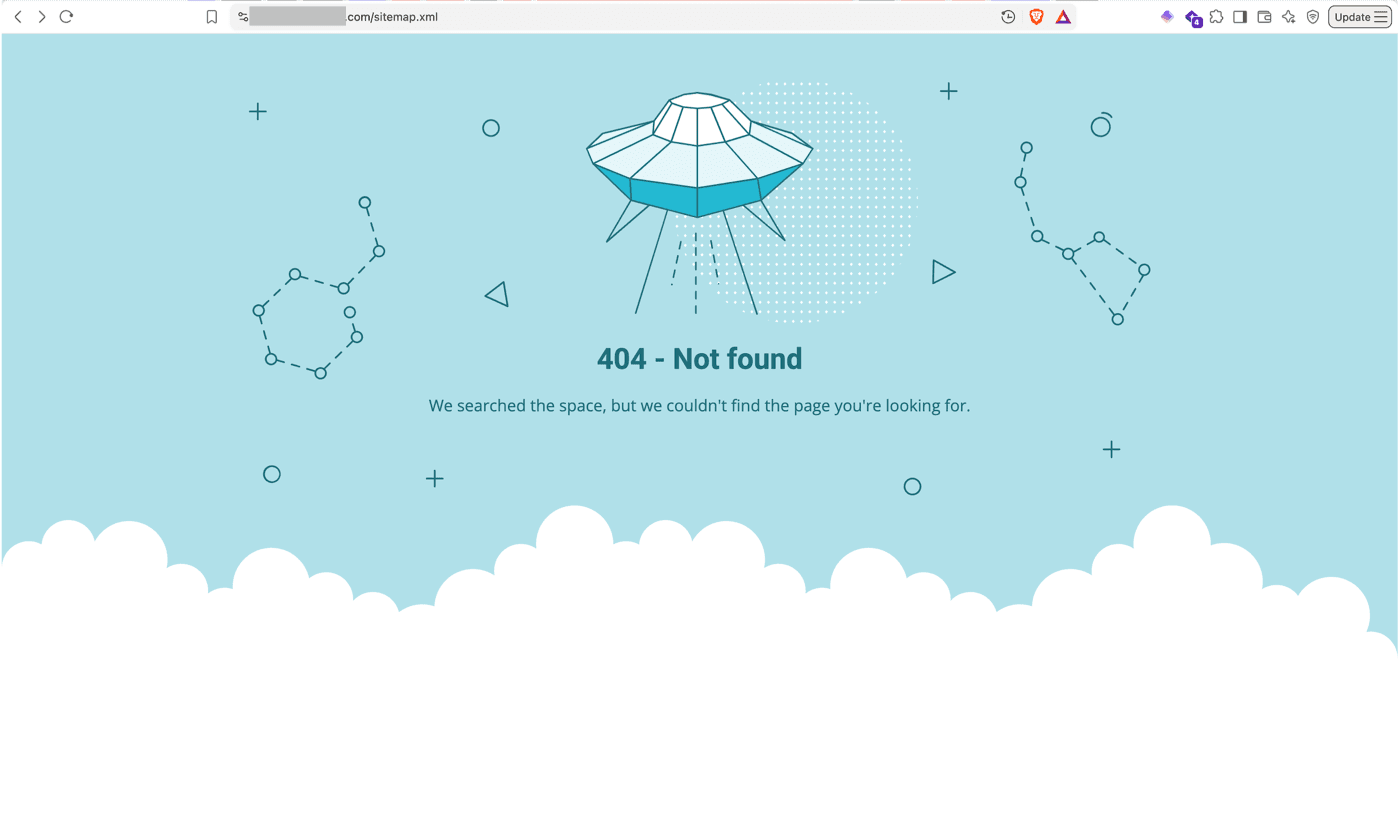
Crawlability. Can a search engine or AI crawler reach the page in the first place? A misconfigured CDN, robots.txt, sitemap, a stray noindex tag, or an orphaned page with no internal linking pointing to it can quietly remove a page from consideration.
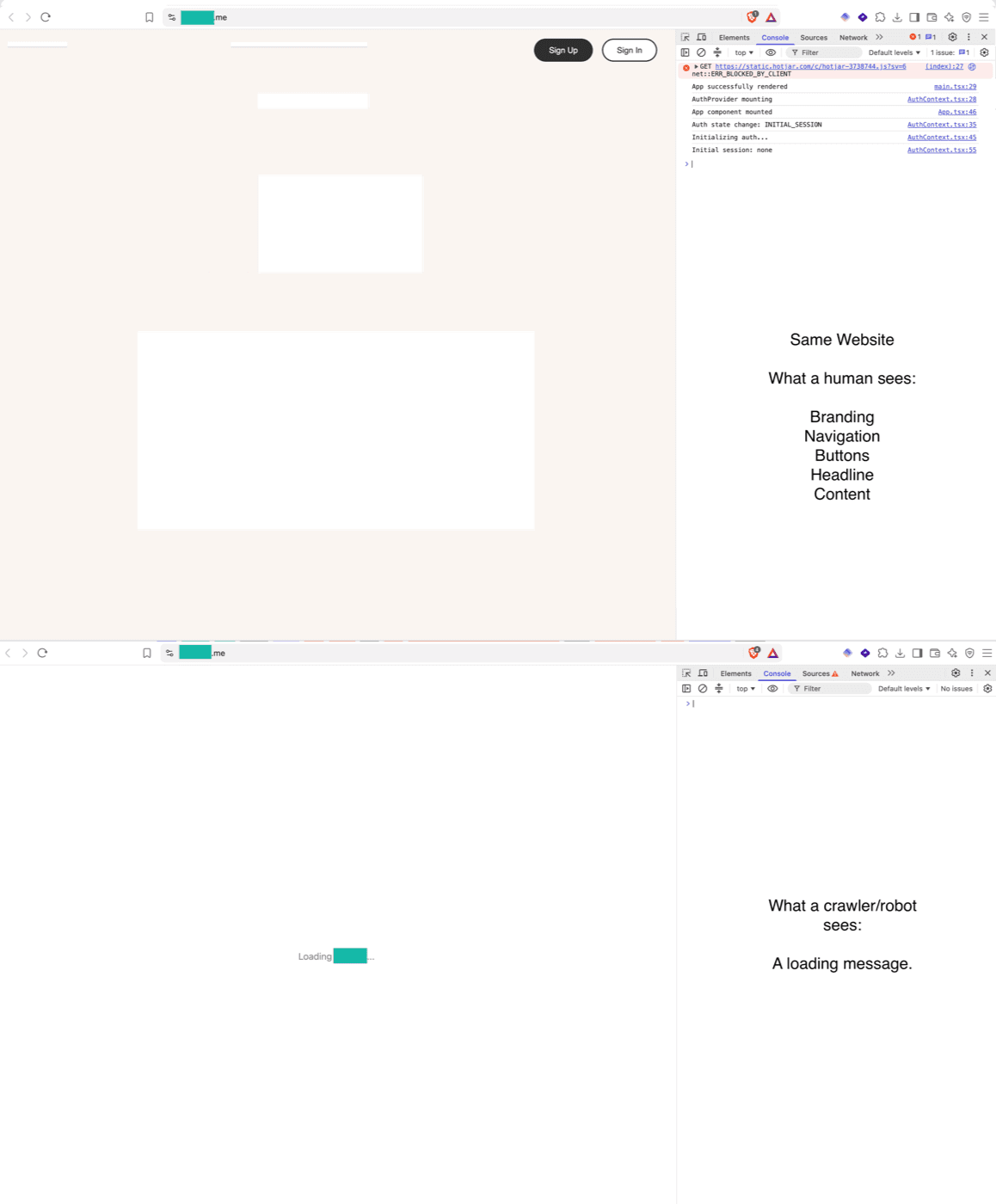
Rendering. Does the content exist in the initial HTML response, or only after JavaScript runs? Many crawlers, AI crawlers especially, don't execute JavaScript the way a browser does. A site that looks complete to a human visitor can be a blank page to a crawler that never triggers the script that builds it.
Indexing and structure. Once a page is reachable and readable, is it structured so a machine can understand what it's about? That's schema markup, a clean entity graph, sensible internal linking, and a site architecture that groups related content instead of scattering it.
None of that is a content problem. It's wiring. And even if you've just had a shiny new website designed, you need to know that many website designers don't even know about this layer at all.
Run your own site through the AI Crawler Checker: it's already run this exact crawl-access check on hundreds of sites, and most of them fail it. A site can look incredible on the surface and still be invisible to the robots that decide whether you get cited in AI answers, show up in organic search, or stay dependent on the social media hamster wheel.
What a technical SEO consultant should check
A proper technical audit runs through a specific list, not a generic scan. At minimum:
Crawl access: robots.txt, sitemap.xml, and whether the AI search crawlers (OAI-SearchBot, Claude-SearchBot, PerplexityBot, and others) can get in, which is a separate check from simply allowing Googlebot.
Rendering: whether the page's content is present in the raw HTML or only appears once JavaScript executes. Disable JavaScript and reload. If the content vanishes, so does most of your visibility to crawlers that don't render scripts.
Canonical tags: whether duplicate or near-duplicate pages point search engines to the correct version.
Schema markup: whether Person, Organisation, Service, Article, and FAQPage JSON-LD (among others) are present, valid, and describing the business rather than a copy-pasted template.
Entity graph: whether the schema across different pages refers back to the same @id, so a search engine reads "this business" as one consistent entity instead of a dozen disconnected fragments. (More on what that means in What Is Entity SEO.)
Site architecture: whether pages are grouped into a coherent structure with internal linking that passes authority to the pages that matter, rather than a flat list of disconnected posts.
Core Web Vitals: page speed and stability, which affect both the reader's experience and how favourably a page gets treated.
What a visitor sees
- Headline
- Body copy
- Images
- Meta description
What's underneath
- robots.txt / CDN / sitemap
- Schema markup
- Entity graph
- JavaScript rendering
- Site architecture
Each of those is checkable. A consultant who can't show you the specific failure in each one, with an example of the real robots.txt line or missing schema field, is giving you an opinion, not an audit.
A robots.txt file that lets Googlebot in can still quietly block OAI-SearchBot, Claude-SearchBot or PerplexityBot, because each crawler can have its own rules, and a restrictive default set once by a developer often just never gets revisited. It isn't a small-site problem, either: HasData's July 2026 index of 10,894 domains found 10.3% block at least one AI crawler outright, rising to 56.4% among the most-cited, highest-traffic sites.
Cloudflare and other CDNs can also turn crawlers away before they ever reach robots.txt. Since 15 September 2026, Cloudflare's Block settings also stop Googlebot, Bingbot and Applebot, so a block meant for AI training can take search with it. The setting that refuses training and keeps search open is Disallow AI Training. Checking the file and the CDN setting takes five minutes. Ask whether it's been done, and ask to see the robots.txt. The correlation is stark: Cloro's research (July 2026) tracked robots.txt rules across 1,058 heavily-cited domains and found that sites blocking GPTBot earn a median of 0.003 ChatGPT citations per Google ranking they hold, against 0.417 for sites that allow it. That's a correlation, not proof that GPTBot decides citations. OpenAI treats GPTBot and OAI-SearchBot as separate settings, and a site that blocks one may well have blocked both.
What they should hand you at the end
The deliverable is where most technical SEO engagements go wrong. A percentage from an SEO plugin and a list of "recommendations" isn't a technical handoff document. It's a screenshot that doesn't come with the personal technical knowhow and nuance that's useful in this line of work.
What you should get instead: a written specification. Which pages need which schema types, with the actual JSON-LD. Which URLs need canonicalising, and to where. What the crawl access gaps are, and the exact fix. A prioritised fix list, in plain language, that you or any developer could implement without a follow-up call to ask what it means.
If the document only makes sense with the consultant standing next to it, it isn't a specification. A schema fix, for example, should read as a field-by-field instruction: which @type, which properties, which page, worded so a developer who has never spoken to the consultant can implement it correctly the first time. (See Schema Markup for Founders for what that instruction should contain.)
Technical SEO vs on-page SEO vs AEO
These three terms are used almost interchangeably, and that's part of why it's hard to know what you're buying and if it's right for you.
On-page SEO works with what's already visible: keywords in headings, readable copy, meta descriptions written for a human. It's real work, and it isn't what a technical SEO consultant is for.
Technical SEO is the infrastructure underneath that content: crawlability, indexing, rendering, schema, site architecture. It doesn't care what the copy says. It cares whether the copy can be found and parsed at all.
Answer engine optimization (AEO) is what happens once both of those are in place: structuring content and its underlying schema so an AI system can lift a direct, accurate answer out of it and cite the source, usually favouring answer-first content over a long preamble. AEO depends on technical SEO being done first. An AI system can't cite a page it couldn't render.
The stakes for getting this right have risen with it. 68% of US Google searches now end without a click (SparkToro, 2026), and that share keeps climbing as AI Overviews and answer engines absorb more of the query.
The three layers aren't competitors. Skipping one to focus on another is why a redesign or a content push changes nothing when the infrastructure layer underneath was never touched.
What technical SEO services cost
Pricing for technical SEO services varies more than most categories in marketing, because the category covers everything from an automated crawl report to a full infrastructure rebuild.
A one-off technical audit for a small business site typically runs from a few hundred dollars for an automated report through to several thousand for a hands-on audit that ends in a written, prioritised fix list. More advanced technical SEO consulting, covering entity graph work and AI crawler access rather than a basic crawl, costs more because it's specification work, not handing over a checklist.
Whether you're comparing a freelance technical SEO consultant, a technical SEO services agency, or a technical SEO services company, what's important is that you get the right deliverable. When you commission a cheap audit that hands you a percentage score and no path to fixing it, it will cost you more later, in the form of a retainer to get someone to explain it. It's always best to have it done properly in the first place.
When you need a consultant, and when you need the architecture designed
If your site has an active technical problem, such as pages that aren't being indexed, a migration that broke something, or Search Console flagging errors, that requires an audit. Something specific is broken, and the job is to find it and hand you the fix.
If nothing is actively broken but nothing is happening either, the site looks fine to a human and the content is decent, yet it still generates no inbound, that's usually not a bug to find. It's site architecture that wasn't designed for discoverability in the first place. And an AEO-first design and specification engagement is built to fix it: building the schema, entity graph, and content architecture properly, once, rather than patching a structure that was never built to hold them.
The two aren't mutually exclusive, and treating them as one purchase is where a lot of budget gets wasted. An audit diagnoses; it doesn't rebuild. If the audit comes back with a handful of specific, containable fixes, hand the list to your developer and you're done. If it comes back showing the whole structure was never wired for this in the first place, that's the signal to stop patching and get the architecture designed properly.
›Sources
- 68% of US Google searches now end without a click, SparkToro, 2026
- GPTBot-blocking domains earn far fewer ChatGPT citations per Google ranking, Cloro Research, July 2026
- 10.3% of sites block an AI crawler in robots.txt, rising to 56.4% among the most-cited sites, HasData, July 2026
- Have it both ways: stay discoverable in search while disallowing AI training, Cloudflare, 15 September 2026
Aimee Q Devlin is a Systems and Infrastructure Architect based in San Miguel de Allende, Mexico. She works with founders and operators of established businesses who are ready to rebuild their systems properly—including the infrastructure that makes those systems discoverable. The PRISM Diagnostic is where engagements begin.
What does a technical SEO consultant do?
A technical SEO consultant audits and fixes the infrastructure underneath a website: crawlability, indexing, JavaScript rendering, schema markup, and site architecture, so search engines and AI crawlers can find, read, and cite the content that's already there.
What should a technical SEO consultant deliver?
A written technical specification: which pages need which schema types, which URLs need canonicalising, what's blocking crawl access, and the exact fix for each, worded in plain language a developer can implement without a follow-up call.
What's the difference between technical SEO and AEO?
Technical SEO makes a site crawlable, indexable, and structurally sound. Answer engine optimization (AEO) builds on that foundation, structuring content so AI systems can extract and cite a direct answer. AEO depends on technical SEO being done first.
What is technical SEO?
Technical SEO is the set of infrastructure factors, crawlability, rendering, indexing, schema markup, and site architecture, that determine whether search engines and AI crawlers can access and understand a website's content at all.
Technical SEO vs on-page SEO: what's the difference?
On-page SEO optimises visible content: headings, copy, meta descriptions. Technical SEO works on what's underneath that content, whether it can be crawled, rendered, and understood by a machine in the first place. Both matter; neither substitutes for the other.
What's the average cost for technical SEO services?
A standalone technical audit typically runs from a few hundred to several thousand dollars, depending on depth. A full infrastructure design and specification is priced by scope rather than by the hour, because it's design work, not a fixed checklist.
Do I need a technical SEO consultant if my site looks fine?
A site can look complete to a human visitor and be structurally invisible to a crawler. If it generates little or no inbound despite looking finished, that's a reason to check the infrastructure underneath it, not just the content sitting on top.